We attend the JANE-2 Annual Meeting alongside the European Cancer Control Network
Our researchers, Sarah Berrocoso and Jone Guenetxea, participated in the event, held in Paris on 6 and 7 November.
The annual JANE-2 Joint Action event and the European Network for Cancer Control (EUnetCCC) meetings brought together representatives of key European initiatives in the fight against cancer in Paris. In this context, researchers Sarah Berrocoso and Jone Guenetxea attended on behalf of the Biosistemak Institute, which plays a strategic role in the project as leader of the sustainability package and co-leader of the evaluation work package, as well as acting as the competent authority in Spain for this European initiative.
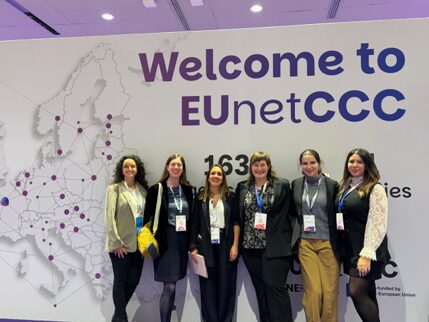
The meeting enabled progress to be made in European coordination to improve cancer prevention, diagnosis and treatment, strengthening collaboration between countries and specialised networks. The presence of Basque entities —including BIOEF, the Basque Government’s Department of Health and Biogipuzkoa— underlined the Basque Country’s commitment to strengthening European cancer control policies.
First-year progress and cooperation between European networks
During its first year, JANE-2 has focused its efforts on creating seven cancer knowledge networks, a key objective for improving coordination between Member States and moving towards more integrated and evidence-based strategies.
The sessions held in Paris provided an opportunity to review the progress made, share lessons learned and explore synergies with EUnetCCC, which aims to improve the quality and coordination of actions in this field. The meeting highlighted the importance of working together to accelerate the implementation of effective policies and improve health outcomes for European citizens.
Likewise, it is coincided with several high-level sessions of the EUnetCCC Annual Meeting, which highlighted the importance of strengthening cancer prevention and early detection in Europe. At one of the round tables dedicated to personalised prevention, representatives from JANE 2 emphasised how the integration of biological, environmental, socio-economic and lifestyle data allows populations to be stratified and preventive interventions to be better targeted, making prevention more effective and equitable. The complementarity between JANE 2 and EUnetCCC was also highlighted, especially in the incorporation of prevention, health literacy and patient participation in future European Comprehensive Cancer Centres. These discussions reinforced a shared vision: to move towards a European model in which personalised prevention and cross-border collaboration are fundamental pillars for improving health outcomes.
The strategic role of Biosistemak in JANE-2
Biosistemak’s contribution to JANE 2 is particularly relevant, as the institute plays a strategic role in two of the project’s cross-cutting work packages. As co-leader of the evaluation package (WP3), Biosistemak is responsible for collecting and analysing the data needed to monitor the progress of the seven Knowledge Networks. In addition, it leads the sustainability package (WP4), where it develops models and tools to ensure the continuity and long-term impact of these networks in the European oncology community. This participation places Biosistemak in a key position within the consortium, contributing directly to the quality, coherence and future viability of the Joint Action.
A European initiative to transform cancer care
JANE 2 is a European initiative driven by the recommendations of the European Plan Against Cancer and aims to establish seven Knowledge Networks designed to address particularly challenging areas of cancer care that can benefit from cross-border collaboration. These networks focus on complex and poor-prognosis cancers, palliative care, survival, personalised prevention, omic technologies, high-tech medical resources and care for adolescents and young adults with cancer. The project aims to make resources such as clinical practice guidelines, quality of care criteria, health and economic models, and support for promoting educational and research opportunities, patient participation, and the prioritisation of cancer strategies in policy-making available to the entire European cancer community.
In addition, the seven thematic networks will work in collaboration with 121 partners from 29 European countries and are supported by several cross-cutting work packages, including coordination, dissemination, evaluation and sustainability. Within this framework, Biosistemak’s role is essential to ensure that the networks created are robust, useful and sustainable over time.